Although time and its measurement is a fundamental component of human life, a special type of clock which takes matters to the next level is the so-called
astronomical clock and whose purpose is not to measure time per se but to convey astronomical information and, in particular, the relative position of the
Sun and Moon as well as the zodiacal constellations and, in some cases, the position of the planets all as a function of time.
The oldest such effort to effectively emulate the overhead celestial sphere (ie a mini-planetarium) is the
Antikythera Mechanism which was discovered in 1901 totally by
accident by sponge divers off the coast of the Greek island of Antikythera. It has been dated to approximately 80 BC and it is believed to be the work of
Poseidonius of Rhodes. The Antikythera Mechanism is currently on display
at the National Archaeological Museum in Athens, Greece.
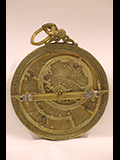
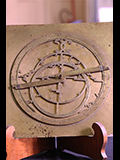
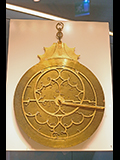
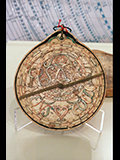
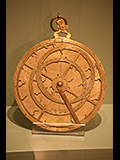
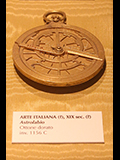
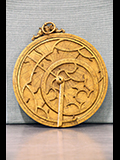
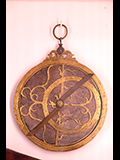
Note: The astrolabe is yet another instrument constructed to describe the overhead sky and monitor time. Some versions also
have religious implications such as the Muslim Qibla where a magnetic compass on the back side of the astrolabe helps the user identify the proper orientation
so as to point at the holy city of Mecca for prayer. Astrolabes were first developed by the Greeks around the second century BC and were slowly adopted
throughout the known world of the time by numerous cultures. Astrolabes describe the position of the planets and prominent stars visible at a particular
latitude (see curved markings on each dial in the photo below) and, by extension, act as time-keeping devices. Similarly, they assist in the time of expected
sunrise which is vital for the Muslim religion and the timing of morning prayers at dawn ("fajr") and thereafter at noon ("dhuhr"), afternoon ("asr"), sunset
("maghrib") and nightfall ("isha"). As a result, it is no surprise that the overwhelming number of astrolabes found in museums around the world are
islamic in origin given the adoption of these instruments from around 700 AD and thereafter by the Islamic World. Today's planispheres can be said to be a
direct extension of the ancient astrolabe, for they function and inform the user of precisely the same information sought-after by users many centuries ago.
Note: For additional results involving astronomical clocks and astrolabes (with astrolabe quadrants) from around the world, please click
here.
Each sample image below is hyperlinked and leads to a dedicated page with greater resolution and further background information.
| Astrolabes and Astrolabe Quadrants From Italy | |||||||||||||||||||||||||
|---|---|---|---|---|---|---|---|---|---|---|---|---|---|---|---|---|---|---|---|---|---|---|---|---|---|
|