
Although time and its measurement is a fundamental component of human life, a special type of clock which takes matters to the next level is the so-called
astronomical clock and whose purpose is not to measure time per se but to convey astronomical information and, in particular, the relative position of the
Sun and Moon as well as the zodiacal constellations and, in some cases, the position of the planets all as a function of time.
The oldest such effort to effectively emulate the overhead celestial sphere (ie a mini-planetarium) is the
Antikythera Mechanism which was discovered in 1901 totally by
accident by sponge divers off the coast of the Greek island of Antikythera. It has been dated to approximately 80 BC and it is believed to be the work of
Poseidonius of Rhodes. The Antikythera Mechanism is currently on display
at the National Archaeological Museum in Athens, Greece.
Note: The astrolabe is yet another instrument constructed to describe the overhead sky and monitor time. Some versions also
have religious implications such as the Muslim Qibla where a magnetic compass on the back side of the astrolabe helps the user identify the proper orientation
so as to point at Mecca for prayer. It is believed that astrolabes were first developed by the Greeks around the second century BC and were slowly adopted
throughout the known world of the time by numerous cultures. Astrolabes describe the position of the planets and prominent stars visible at a particular
latitude (see curved markings on each dial in the photo below) and, by extension, act as time-keeping devices. Similarly, they assist in the time of expected
sunrise which is vital for the Muslim religion and the timing of morning prayers. Today's planispheres can be said to be a direct extension of the ancient
astrolabe, for they function and inform the user of precisely the same information sought-after by users many centuries ago.
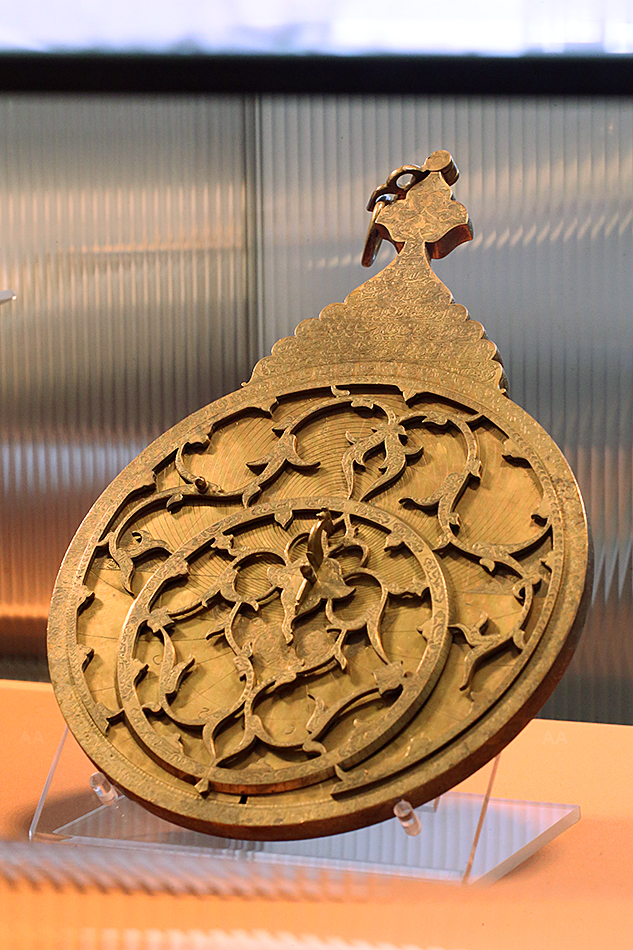
The large brass astrolabe below is one of four astrolabes currently on display at the Victoria and Albert Museum in London. The craftsman behind its manufacture
is Abd al-Ghafur from Urmia, Iran, and is dated 1781 AD. There exist at least seven other astrolabes by Abd al-Ghafur in museums around the world including
two samples in Washington (National Museum of History and Technology) and one each in Chicago (Adler Planetarium) and Leningrad (Hermitage Museum). This astrolabe
is one of the largest to be produced in Persia measuring 35.5 cm in height (including the large crown), 20.3 cm in diameter, a thickness of 3 mm and weighing 2.9 kg.
An impressive collection of seven tympanums accompany the astrolabe serving latitudes between 29° N and 46° N. The crown has multiple lines of text and may involve
verses from the Qur'an or blessings on The Prophet Muhammad and the 12 Shi'a imams. The rete is particularly decorated with various interconnected and complex
patterns of stems and leaves which are used as star pointers; a very characteristic feature of astrolabes produced in Iran during the 16th and 17th centuries. The
assymetrical rule is very basic and quite truncated. The availability of seven latitude-specific plates characterize the astrolabe as planespheric in nature, for
it projects the three-dimensional celestial sphere onto a two-dimensional plane comprised of disks with the latter correcting for differences due to latitude. During
the Middle Ages, three-dimensional astrolabes were first described but only one such example seems to have survived to present day and which can be found at the
History of Science Museum in Oxford, England (travel and photography forthcoming).
The Victoria and Albert Museum in London is one of the premier museums in the city with over 2.8 million works in its collection comprised of five thousand
years worth of human creativity and inspiration. The foundation stone was laid by Queen Victoria in 1899 with the museum having expanded dramatically to now
include five venues across London with the South Kensington branch having four astrolabes currently on display (room 42: Islamic Middle East section;
room 99: Photography; and room 116: Metalware). The museum is open daily between 10:00 and 17:45 (10:00 to 22:00 on Fridays) and admission is free with no
advance booking required. Access to the museum is trivial using London's undergound tube and where one exits at the "South Kensington" station (easily reachable
by the District, Circle and Piccadilly lines) and follows an underground tunnel approximately 750 meters in total length. A brief walk leads to the proper
underground entrance to the V&A Museum approximately halfway through the tunnel. Walking the full length of the tunnel leads to an exit above ground and which
immediately leads one to the Science Museum no more than 20 meters away to the right as they exit (the Science Museum is physically across the street from the
V&A Museum).
Note: For additional results involving astronomical clocks and astrolabes (including astrolabe quadrants) from around the world, please click
here.
|
Body: Sun Mass: 332,900 x Earth Mass Eq Diameter: 109.1 x Earth Distance: 149 million km RA / Dec: 23h 41m 41s / +89° 19' 51" Diameter: 32.16' Magnitude: -26.8 |
 |
Date: Dec 10, 2024 Location: Victoria & Albert Museum, London, England Equipment: Canon EOS 6D Baader BCF2 Filter Canon EOS EF 70-200mm f/4 L @ 94mm / f11.0 Exposure: 1 x 1/4 sec ISO 6400 JPG Fine Image Format 5472x3648 Image Size Custom White Balance Continuous Servo Mode Manual Mode Software: Photoshop CS6 Processing: White Balance Adjustment Resampling JPG Compression |