
Although time and its measurement is a fundamental component of human life, a special type of clock which takes matters to the next level is the so-called
astronomical clock and whose purpose is not to measure time per se but to convey astronomical information and, in particular, the relative position of the
Sun and Moon as well as the zodiacal constellations and, in some cases, the position of the planets all as a function of time.
The oldest such effort to effectively emulate the overhead celestial sphere (ie a mini-planetarium) is the
Antikythera Mechanism which was discovered in 1901 totally by
accident by sponge divers off the coast of the Greek island of Antikythera. It has been dated to approximately 80 BC and it is believed to be the work of
Poseidonius of Rhodes. The Antikythera Mechanism is currently on display
at the National Archaeological Museum in Athens, Greece.
Note: The astrolabe is yet another instrument constructed to describe the overhead sky and monitor time. Some versions also
have religious implications such as the Muslim Qibla where a magnetic compass on the back side of the astrolabe helps the user identify the proper orientation
so as to point at Mecca for prayer. It is believed that astrolabes were first developed by the Greeks around the second century BC and were slowly adopted
throughout the known world of the time by numerous cultures. Astrolabes describe the position of the planets and prominent stars visible at a particular
latitude (see curved markings on each dial in the photo below) and, by extension, act as time-keeping devices. Similarly, they assist in the time of expected
sunrise which is vital for the Muslim religion and the timing of morning prayers. Today's planispheres can be said to be a direct extension of the ancient
astrolabe, for they function and inform the user of precisely the same information sought-after by users many centuries ago.
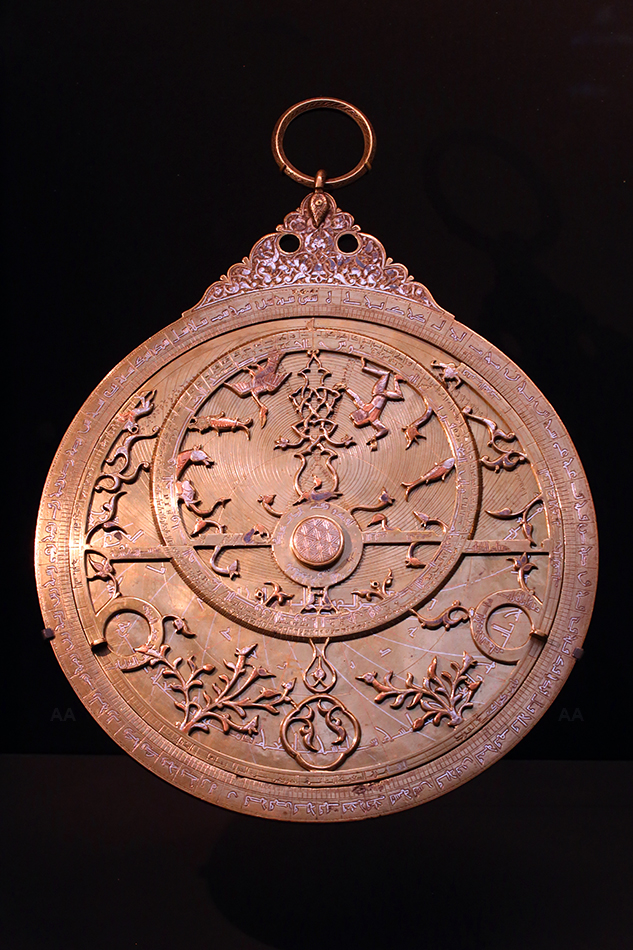
The large and exquisite brass astrolabe below is currently on display at the British Museum (London) and forms part of the Albukhary Foundation Gallery of the
Islamic world on Level 3 (rooms 42 and 43) where a total of nine astrolabes are on display. The astrolabe was crafted by the Egyptian astrolabist
Abd al-Karim al-Misri and who is believed to have worked in the Mesopotamia region. The astrolabe is quite large and is characterized with a height of 46 cm
including the throne, a diameter of 32.50 cm and a thickness of 5.80 cm. The rete is particularly unique given the figural designs of the constellations which
effectively translate to multiple star pointers each and which embelish the overall appearance. A reference to al-Malik, al-Muizz and Shihab al-Din on the
back side refer to two sultans and rulers of the time (the third name remaining a mystery and the source of much academic debate), thus suggesting the astrolabe
was perhaps more of a showpiece rather than an instrument for daily use; this is amplified by the exquisiteness and large size of the astrolabe as well as the
noticeable inlaid work using silver. Noted astrolabe specialist and historian David King noted the immense similarity of a Syrian astrolabe at the Maritime Museum,
Istanbul, Turkey, made for al-Muazzam Isa of Damascus during 1222-1223 AD and the astrolabe below (vis a vis figural design with inlaid silver) and suggested
that Abd al-Karim's two known astrolabes - the work below and the sample at Oxford's Museum for the History of Science - follow the Syrian tradition and they
should be labelled as such. Inspection of the mater and the underlying tympanum clearly indicates that the astrolabe is planespheric in nature, for it
projects the three-dimensional celestial sphere onto a two-dimensional plane comprised of disks with the latter correcting for differences due to latitude.
During the Middle Ages, three-dimensional astrolabes were first described but only one such example seems to have survived to present day and which can be found at
the History of Science Museum in Oxford, England (travel and photography forthcoming). For further information on this exquisite astrolabe and its craftsman,
Abd al-Karim, see the in-depth article by Rachel Ward
here.
The British Museum in central London is widely regarded as one of the finest museums in the world. Founded in 1753 AD, the British Museum boasts the largest
permanent collection in the world with over eight million works, is comprised of ninety-four galleries and is rewarded with about six million visitors annually.
Admission to the British Museum is free but an online ticket reservation is highly recommended for quick entry with visitation hours being between 10:00 and 17:00
daily with Friday's closing hour being later (20:30). Public transportation includes four stations all around the museum (Tottenham Court Road, Holborn, Russell
Square and Goodge Street).
Note: For additional results involving astronomical clocks and astrolabes (including astrolabe quadrants) from around the world, please
click here.
|
Body: Sun Mass: 332,900 x Earth Mass Eq Diameter: 109.1 x Earth Distance: 149 million km RA / Dec: 23h 41m 41s / +89° 19' 51" Diameter: 32.16' Magnitude: -26.8 |
 |
Date: Dec 09, 2024 Location: British Museum, London, England Equipment: Canon EOS 6D Baader BCF2 Filter Canon EOS EF 70-200mm f/4 L @ 70mm / f11.0 Exposure: 1 x 1/20 sec ISO 6400 JPG Fine Image Format 5472x3648 Image Size Custom White Balance Continuous Servo Mode Manual Mode Software: Photoshop CS6 Processing: White Balance Adjustment Resampling JPG Compression |